
People use “notebook” and “journal” almost interchangeably, but the two words hide a real fork in how writing gets organized — and picking the wrong side of it is why so many note systems die in week three. The difference isn't the paper or the app. It's the axis: a notebook is organized by topic. A journal is organized by time.
Two questions, two shapes
Every note you write will be looked up later by one of two questions: “What do I know about X?” or “What happened on that day?” A notebook answers the first — the lab notebook, the commonplace book, the project binder, where related things sit together regardless of when they were written. A journal answers the second — the diary, the captain's log, where things sit in order regardless of what they're about.
Paper made you commit to one. A page glued into the chemistry section can't also be in Tuesday. So we grew up thinking of them as different objects — the notebook on the desk, the journal by the bed.
The trouble: your day doesn't split itself
Sit through one ordinary working day and watch what you actually write: a standup note, a todo, a decision about the billing bug, a phone number, a feeling about a hard conversation, an idea for a side project. Some of it is notebook material, some journal material — but it arrives interleaved, in time order, because that's the only order a day comes in.
Topic-first apps (folders, notebooks, wikis) tax every one of those lines with a filing decision: where does this go? Each decision is small, but capture has to cost near-zero or it stops happening. Journal apps have the opposite problem: capture is easy, but your working notes — the decision, the phone number — get buried between reflections, and the apps themselves treat entries as something to preserve, not to work in. Todos don't belong in a diary.
Software doesn't have glue
Here's what paper couldn't do: on a computer, a line can live in time and be found by topic. Write everything into the day — zero filing decisions, journal-style — and let search and tags rebuild the notebook view whenever you need it. Time is the index you get for free; topic is the index the computer can compute.
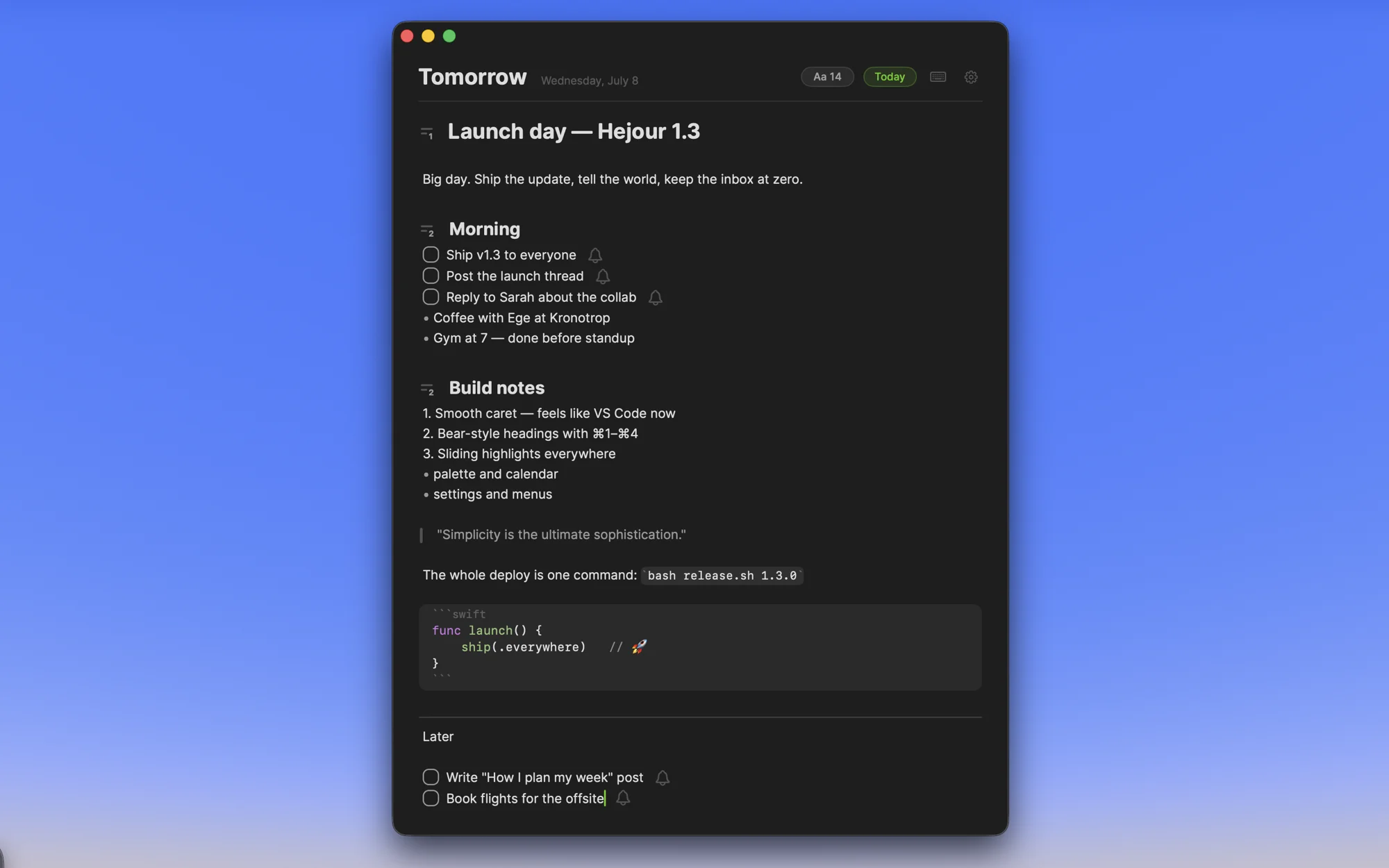
This is the whole idea behind day-based notes apps, and it's how Hejour is built: every day is a page, and everything you write lands on today — todos next to meeting notes next to one honest sentence about the hard conversation. Then the notebook view is recovered on demand: #billing turns a topic into a thread you can pull from ⌘P — every day it touched, every line that mentioned it — and ⌘P itself searches every line of every day. The journal you kept becomes the notebook you need, at lookup time instead of capture time.
So which do you actually need?
- A journal app (Day One and friends) — if you write mainly to remember and reflect: long entries, photos, on-this-day memories.
- A notebook app (Obsidian, Notion, Bear) — if you write mainly reference material you'll re-edit for years: a wiki, a manual, a library.
- A day-based app — if your writing is the daily churn of work and life: todos, logs, decisions, small reflections, all mixed. Write it journal-style, find it notebook-style.
If the third one sounds like your days, Hejour is a free download — a notebook and a journal in the same file, one page per day.